Rug Size Guide UK (Living Room, Bedroom & Dining)
Size is the single most impactful decision when choosing a rug. Get it right and the room looks balanced, grounded, and intentional. Get it wrong and even the most beautiful rug feels out of place. This is the only sizing reference you need.
Quick Answer
Living room: 200×290 cm (standard) or 250×350 cm (open-plan). Bedroom: 200×300 cm under a king bed. Dining room: 300×400 cm for a 6-seater table. Always leave 25–45 cm of exposed floor around the rug.
UK Standard Rug Sizes at a Glance
These are the standard rectangular rug sizes available in the UK market, listed in centimetres:
| Size (cm) | Best For | Room Size |
|---|---|---|
| 120 × 170 | Accent / beside bed | Small |
| 160 × 230 | Double bed / compact living room | Small–Medium |
| 200 × 290 | Standard living room / king bed | Medium |
| 250 × 350 | Large living room / dining room | Large |
| 300 × 400 | Open-plan / 6+ seater dining | Extra Large |
Need help choosing between sizes? Try our rug size calculator for an instant recommendation based on your room dimensions.
Living Room Rug Sizes
The living room is where rug sizing has the most visible impact. A rug that's too small makes the room feel disjointed; the right size ties everything together.
The Front-Legs-On Rule
Place at least the front legs of your sofa and armchairs on the rug. This anchors the seating area and creates a unified zone. A 200×290 cm rug achieves this in most standard UK living rooms (3.5–4.5 m wide). For detailed placement layouts, see our living room rug placement guide.
Open-Plan and Large Rooms
For rooms wider than 4.5 m, step up to 250×350 cm or 300×400 cm. In open-plan spaces, the rug effectively defines the seating zone — so it needs to be large enough to contain the full arrangement. Read our large rugs guide for more detail.
Small Living Rooms
In compact rooms (under 3.5 m wide), a 160×230 cm rug works when furniture is arranged tightly. Counterintuitively, going slightly larger — to 200×290 cm — often makes a small room feel bigger by reducing the patchwork effect of visible floor edges. We cover this in depth in our small living room rug size guide.
Bedroom Rug Sizes
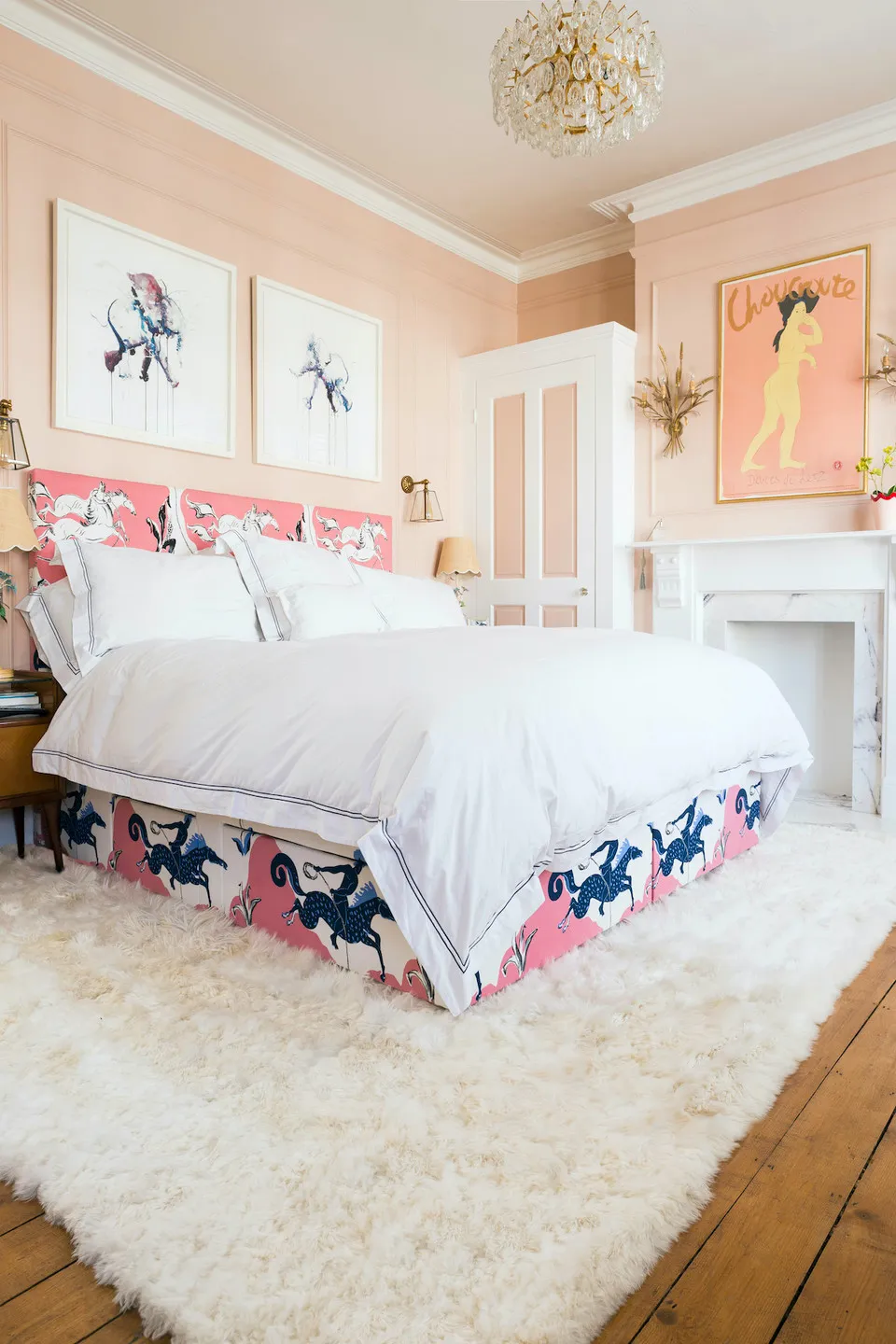
Bedroom sizing is driven entirely by the bed. The rug should extend at least 45 cm beyond the sides and foot of the bed to create a soft landing zone.
King Size Bed (150 × 200 cm)
The ideal rug is 200×300 cm for a standard fit or 240×340 cm for a more generous look. Position the rug so the top third tucks under the bed, leaving a balanced surround on three sides. For full king bed layouts, see our king bed rug size guide.
Double Bed (135 × 190 cm)
A 160×230 cm rug suits tighter rooms, while 200×290 cm gives a more expansive feel. In either case, the rug should be visibly wider than the bed when viewed from the doorway. Full guidance is in our double bed rug size guide.
Bedside Runners
An alternative to a single large rug: two runners (60×180 cm or 70×240 cm) placed symmetrically on either side of the bed. This works well in narrow rooms where a full under-bed rug would be disproportionate.
Dining Room Rug Sizes
Dining rugs need to accommodate chairs when pulled out — not just pushed in. This is the most common sizing mistake in dining rooms.
The 60 cm Rule
Add 60 cm to every edge of your dining table. This ensures chairs remain on the rug surface even when occupied. A standard 180×90 cm table requires a minimum of 300×210 cm — rounding to 300×400 cm in practice for visual balance and to account for chair positioning at the heads.
Round Dining Tables
For a 120 cm diameter table, a 240 cm or 250 cm round rug provides the necessary clearance. For larger 150 cm tables, step up to a 280 cm or 300 cm diameter.
The Floor Border Rule
Regardless of room type, aim for 25–45 cm of exposed floor between the rug edge and the nearest wall. This creates a frame that makes the rug look deliberately placed. Less than 20 cm and the rug looks like it was meant to be wall-to-wall but fell short. More than 60 cm and the rug starts to feel like an island.
When to Go Custom
If your room dimensions fall between standard sizes, or if you have an L-shaped layout, bay window, or architectural feature that disrupts standard proportions, a custom-sized rug delivers a tailored result that standard sizes simply can't match. All of our designs are available in bespoke dimensions.